- Home
- Start Here
Where to Start With Spanish
Maybe you're completely new to Spanish. Maybe you've tried before and it didn't quite stick. Maybe you've just spent an hour scrolling through app reviews and "best course" comparisons and still don't know what to actually do.
None of that means anything is wrong with you. The problem usually isn't a lack of options — there are more apps, courses, books, and videos than anyone could get through. The harder part is knowing how all those pieces fit together, and what to do first.
You don't need more options. You need a process you can actually follow.

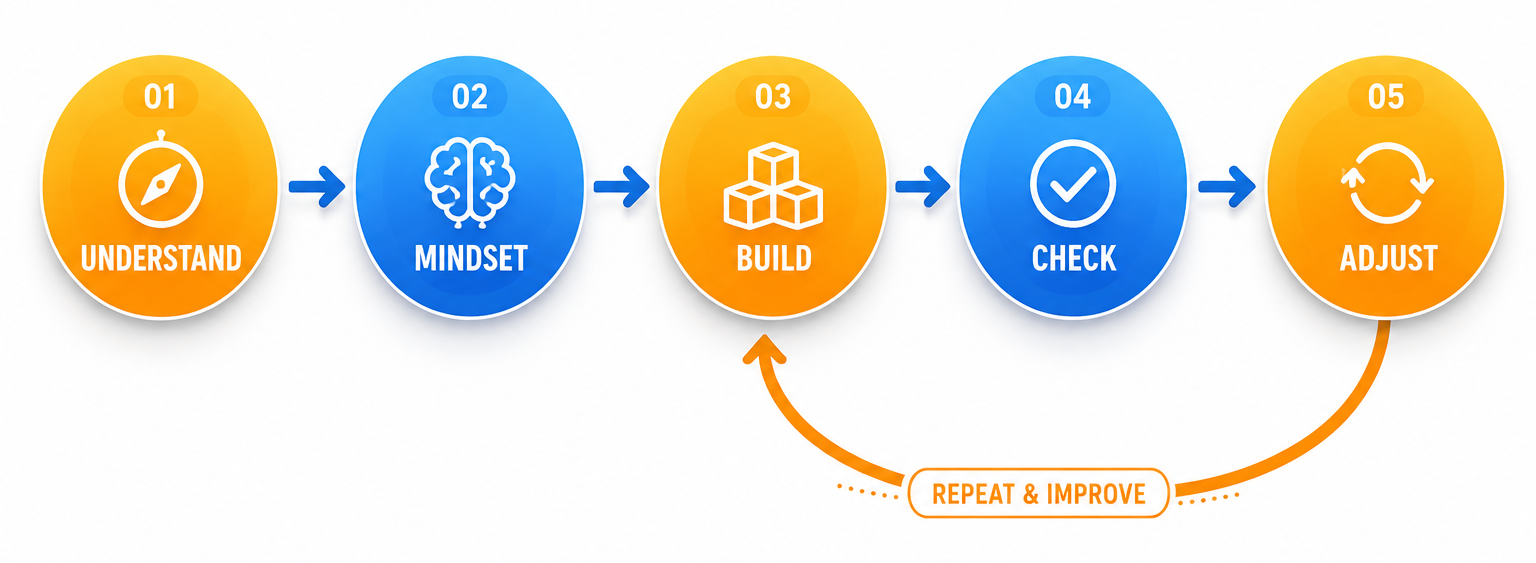
Here it is, in five steps:
- Understand what the process looks like
- Get into the right mindset
- Build the right mix of resources for you
- Check whether it's actually working
- Adjust and keep going
Let's walk through each one.
→ Start with the free Spanish Learner's Mindset Guide
Step 1: Understand What the Process Looks Like
Before anything else, it helps to know roughly what you're walking into. Most people picture language learning as a straight line — study, improve, eventually fluent. In practice, it's more like a series of stages, each with its own feeling.
At first, everything is new. Words don't stick yet, and sentences sound like one long blur. This is normal, and it passes faster than it feels like it will.
Then you start recognizing pieces. You catch a word here, a phrase there. Spanish stops sounding like noise, even if you can't hold a full conversation yet.
Then understanding outpaces speaking. This is the stage that frustrates people most — and it's also the most normal one. Almost everyone understands more than they can say. It doesn't mean something's wrong with your approach.
Then you can communicate, imperfectly. You can get your point across, make mistakes, and keep going. This is a real milestone, even though it doesn't feel like "fluency" yet.
And progress keeps coming in bursts, not a straight climb. Weeks where everything clicks, weeks where nothing seems to move. Both are part of the same process.
Knowing this in advance means you won't mistake normal difficulty for failure. Wherever you are on this list, you're not behind — you're at a stage.
The useful question isn't just "what stage am I at?" It's: what does my current experience tell me to work on next? That question is what the rest of this page helps you answer.
Step 2: Get Into the Right Mindset
Good resources matter. But constantly searching for a better app, course, or book isn't a substitute for understanding how to actually use the resources you have. The right resource can help enormously — but understanding how learning works helps you get far more out of whatever good resources you choose.
That's what the Spanish Learner's Mindset Guide is for. It's free, takes about 15 minutes to read, and it's a practical starting point for understanding how language learning works and how to approach Spanish effectively — before you decide what resources to use.
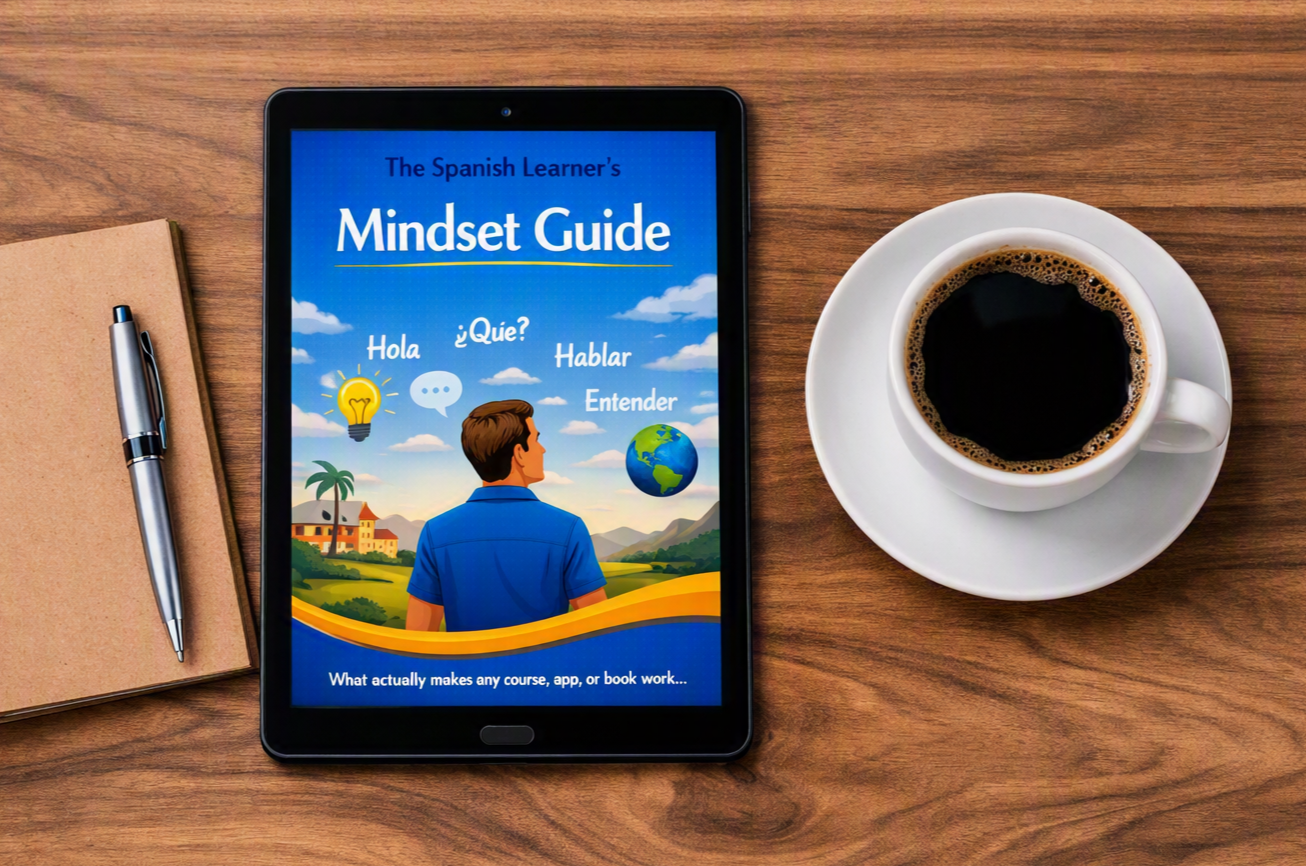
It won't hand you a list of apps, courses, or books to buy. Instead, it covers things like:
- Why vocabulary isn't necessarily the bottleneck. Most learners already know more words than they can use. The guide explains why, and what to focus on instead.
- Why understandable exposure matters — being exposed to Spanish you can mostly follow, whether that's a show, a conversation, or a simple article, and how to build that into your routine.
- Why translating in your head can slow you down, and how to gradually build more direct understanding instead.
- How grammar helps, and where too much of it becomes counterproductive.
- Why listening can feel harder than reading, and what tends to close that gap.
- How reading, listening, speaking, and writing reinforce each other, so you're not accidentally neglecting the one that unlocks the rest.
- How to move from understanding something to actually being able to use it — often the biggest hurdle for intermediate learners.
- How to stay consistent without relying on motivation alone.
→ Get the free guide — delivered straight to your inbox
Step 3: Build the Right Mix of Resources for You
Once you've got a sense of how learning works, it's time to choose what you'll actually use day to day. This is where most people start — and where most people get overwhelmed, because there's no single best course, app, or book. There's only what fits you.
A few things worth thinking about:
What works well for you. Do you prefer clear structure and steps, or figuring things out independently? Do you get more out of listening, reading, or actual conversation? These are preferences, not fixed categories — most people are a mix, and that mix can shift over time.
Your personality. Are you motivated by accountability and interaction with other people, or do you focus better working on your own?
Your lifestyle. Do you have dedicated study time, or do you need something that fits into a commute, a lunch break, or a few minutes before bed?
You don't need to nail this on the first try, and you don't need ten resources. Usually two or three that work well together — something for structure, something for exposure, something for actually speaking — is plenty.
If you're not sure what overall approach to take — classes, self-study, tutoring, immersion, or some combination — start with [Ways to Learn Spanish](link: ways-to-learn-spanish). If you already know the general approach and want specific tools and materials — courses, apps, books, podcasts, shows — go to [Best Resources to Learn Spanish](link: best-resources-to-learn-spanish).
Step 4: Check Whether It's Actually Working

After some time with your chosen mix, it's worth pausing to check whether it's actually moving you forward — not through a rigid test, just an honest look at how things feel. The goal here is to tell the difference between "this is just hard" and "something needs to change."
A few common signs worth paying attention to:
"I know a lot of words but freeze up when I try to speak." This usually points to a need for more speaking practice specifically, not more vocabulary.
"I understand grammar rules but can't use them naturally." Knowing a rule intellectually and using it automatically are different skills. This usually calls for more contextual exposure and real use, not more explanations.
"I can read fine but can't follow spoken Spanish." Reading and listening are separate skills. This usually means more listening practice at a level you can follow.
"I've been consistent, but nothing feels different." Consistency is important, but it doesn't guarantee the current resource, level, or routine is the right fit. That's worth a second look.
None of these mean something is wrong with you. They just point to where to adjust.
Step 5: Adjust and Keep Going
This is where you close the loop. Based on what Step 4 showed you, make one specific change rather than overhauling everything:
- Freezing up when speaking? Add regular, low-pressure speaking practice.
- Grammar that won't stick in conversation? Spend less time on explanations and more time encountering and using the pattern in context.
- Struggling with listening? Add regular listening that's understandable enough to follow.
- Consistent but stuck? Revisit Step 3 and reconsider the fit of your resources or routine.
Then check in again in a few weeks. This isn't a one-time checklist — Steps 3 through 5 form a loop:
Build the Right Mix → Practice → Check → Adjust → Repeat
You Know What Your Next Step Is
You don't need the perfect app, the perfect course, or a perfect plan before you begin. You need a way to understand where you are, choose what fits, practice, check what's working, adjust, and continue.
That's the whole process. There are a lot of ways to learn Spanish, but you don't need to figure them all out today.
Not sure where to begin? Start with the free Spanish Learner's Mindset Guide.
→ Get the free Spanish Learner's Mindset Guide
→ Explore Best Resources to Learn Spanish
Stay inspired on your Spanish journey with occasional updates, new articles, and helpful resources.